Consumer Discretionary
Nike, Inc.
Water dependencyVery Low
Nike, Inc. is a U.S.-based athletic footwear, apparel, and equipment company headquartered in Beaverton, Oregon. The company is known for Nike footwear, sportswear, Jordan, Converse, and global supplier manufacturing. Elliott Hill is the CEO of Nike. Since Nike depends mainly on water for textile dyeing, water use is a small part of its ESG issues.
Nike's main progress on water use comes from a combined approach with its suppliers and cotton sourcing. In textile dyeing and finishing, Nike lowered its freshwater use per kilogram from 84.4 L/kg in FY20 to 71.4 L/kg in FY24, a 15.4% reduction. The company also cut total freshwater use in these processes from 20,609 million liters in FY20 to 18,021 million liters in FY24, a decrease of 2,588 million liters, or 12.6%, even as supplier production conditions can change each year.
Nike also shares details about where its textile-processing water comes from. In FY24, 11,748 million liters came from municipal water, 4,558 million liters from groundwater, 1,321 million liters from surface water, 26 million liters from rainwater collection, and 368 million liters from condensate. Together, rainwater and condensate made up 394 million liters, or about 2.2% of the total freshwater used for textile dyeing and finishing in FY24.
Nike's work to restore water in its cotton supply chain stands out. By FY24, the company reported restoring 6.9 billion liters of water, up from 5.2 billion liters in FY23. Most of this came from Australia, with 6.7 billion liters, while Pakistan contributed 121.8 million liters, India 43.2 million liters, and Brazil 1.5 million liters. Since July 2019, Nike has invested $2.025 million in water restoration projects in Australia, India, Pakistan, Brazil, and the United States.
Nike's projects cover a wide range of activities, not just water volume. The company has supported efforts like reducing agricultural water demand in Maharashtra, conserving land and restoring wetlands in Australia, building rainwater harvesting and drinking water systems in Pakistan, improving wetland treatment and irrigation efficiency in South Punjab, reconnecting floodplains in Louisiana, and restoring land and vegetation in Brazil. This approach focuses on the health of entire watersheds, not just factory efficiency.
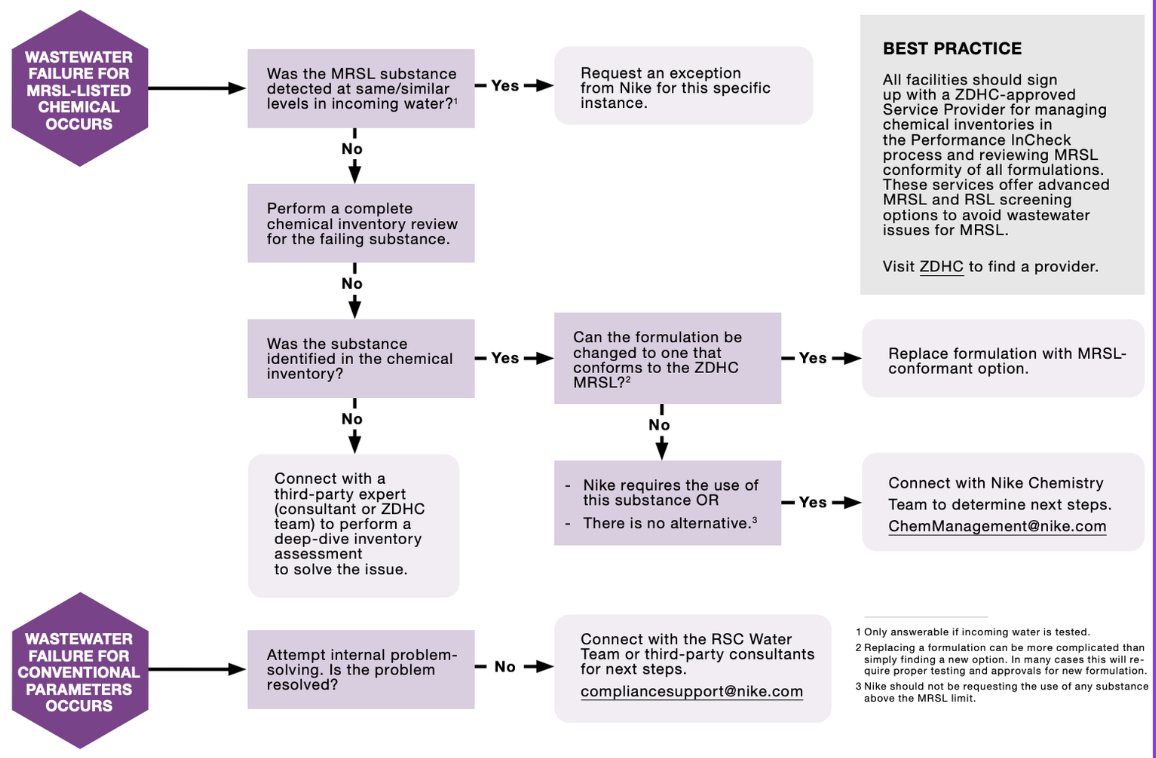
Nike links its water stewardship efforts to preventing pollution. The company stopped using C8-based durable water-repellent finishes and reported that all DWR finishes used in Nike products were PFAS-free as of 2022. Nike's work on clean chemistry and sharing knowledge, similar to the GreenXchange model, shows it is trying to improve water practices beyond its own products.
One shortfall is that Nike is transparent about textile dyeing and finishing data, but it does not share a full company-wide water withdrawal figure, water-stressed exposure, or wastewater discharge volume. Nike also does not run restoration projects itself. Instead, it funds third-party NGOs and relies on outside engineering firms to estimate restoration volumes. This approach does not weaken the work, but it means the restored-water numbers depend a lot on how these external projects are designed and measured.
3 Key Metrics of Nike, Inc, FY24
- Total water use / consumption / withdrawal
- Not quantified companywide; textile dyeing/finishing freshwater use: 18,021 million L of withdrawal.
- Water intensity
- 71.4 L/kg for textile dyeing and finishing.
- Water-stressed region exposure
- Not reported.
Supplemental metrics
- Water replenished / restored
- 6.9 billion L.
- Project-level water savings
- 2,588 million L lower textile dyeing/finishing freshwater use vs. FY20; 15.4% lower intensity.
- Alternative water sources
- 394 million L rainwater + condensate.
- Restoration funding
- $2.025 million cumulative since July 2019.
Analysis reference: nike-inc