Consumer Discretionary
Tesla, Inc.
Water dependencyModerate
Tesla, Inc. is a U.S.-based electric vehicle, battery, energy storage, and technology company headquartered in Austin, Texas. The company produces vehicles, battery systems, solar products, charging infrastructure, and related software. Elon Musk is the CEO of Tesla. Because Tesla operates vehicle factories, battery facilities, lithium refining, and data-center infrastructure, water use is moderately tied to its manufacturing efficiency and environmental performance.
Tesla focuses on improving water efficiency. In 2025, Tesla used 5,447,800 cubic meters of freshwater for manufacturing, down from 6,042,627 cubic meters in 2024. This is a drop of about 9.8%. The company also saw a 7.1% year-over-year decrease in water use per $1 million of revenue, showing that water efficiency improved even as production continued across different lines.
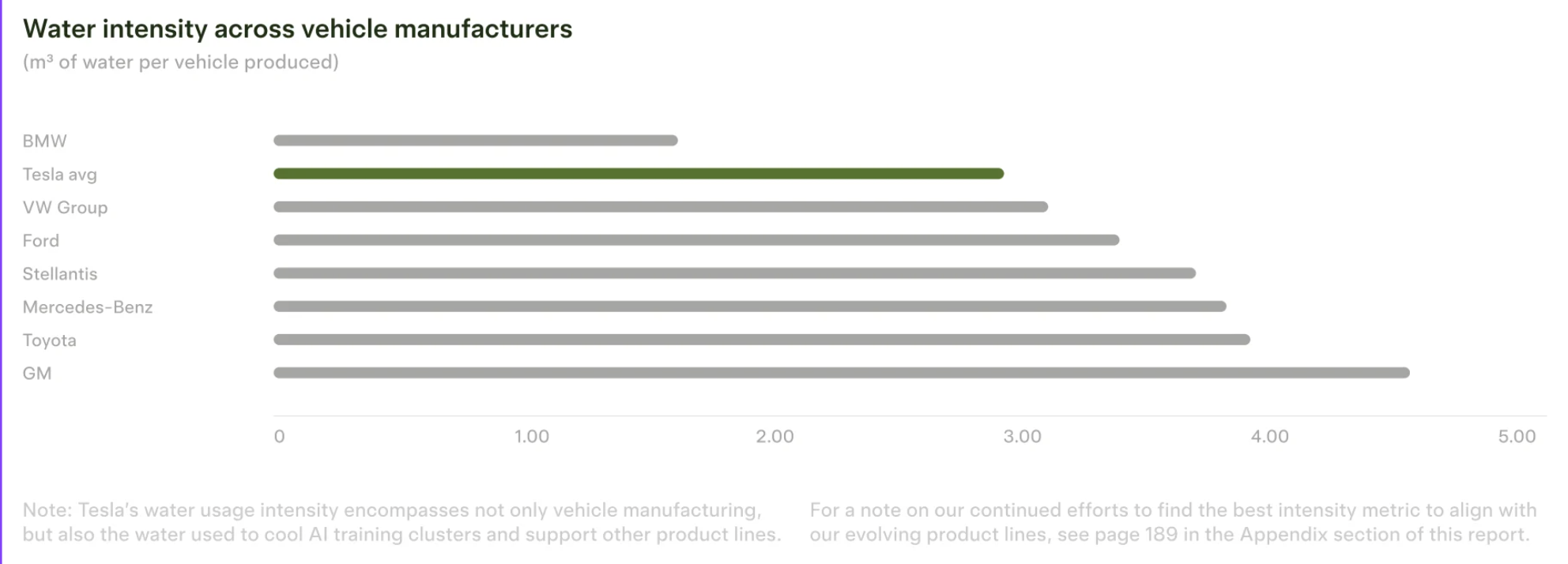
A clear example is Gigafactory Berlin-Brandenburg. In 2025, its water use per vehicle was 1.51 cubic meters, and the site used about 0.3 million cubic meters of water, well below its allowed limit of 1.4 million cubic meters per year and less than the 0.45 million cubic meters used in 2024. Tesla also started a water recovery and recycling plant there, which is designed to recycle up to all of the factory's process wastewater. Since there have been local concerns about industrial water use, using less water helps reduce local risks as well as improve efficiency.
Tesla also uses water recycling at its Gulf Coast lithium refinery. The refinery reuses much of its water, and any leftover discharge is monitored under its permit. According to Tesla, its lithium conversion technology cuts total water discharged by 80% compared to the usual acid-alkaline process. At Megafactory Lathrop, better wastewater management reduced water use in the powder coating process by 90%.
At Gigafactory Texas, Tesla is adding systems to save water by using rainwater, condensate, and reclaimed water. The site is set up to collect at least 25% of rainwater from the roof in underground tanks, then reuse it to cool manufacturing equipment. Tesla expects this to save about 14 million gallons of city water each year. Reusing condensate could save another 13.6 million gallons, and using more reclaimed water could save nearly 150 million gallons per year once everything is running. However, many of these numbers are estimates or planned savings and have not yet been fully confirmed.
3 Key Metrics of Tesla, Inc, 2025
- Total water use / consumption / withdrawal
- 5,447,800 cubic meters of freshwater withdrawal.
- Water intensity
- 1.51 cubic meters per vehicle at Gigafactory Berlin-Brandenburg; total water per $1 million in revenue decreased 7.1% year over year.
- Water-stressed region exposure
- Not reported.
Supplemental metrics
- Water recycled / reused
- Up to 100% of factory process wastewater at Gigafactory Berlin-Brandenburg.
- Wastewater discharge reduction
- 80% lower total water discharge at the Gulf Coast lithium refinery compared with the standard acid-alkaline process.
- Project-level water savings
- 90% water-use reduction in Megafactory Lathrop's powder coating process.
- Project-level water savings
- About 14 million gallons of potable city water saved annually from Gigafactory Texas rainwater capture.
- Project-level water savings
- 13.6 million gallons conserved annually from planned condensate reuse at Gigafactory Texas.
- Project-level water savings
- Just under 150 million gallons of potable city water saved annually from planned reclaimed-water deployment at Gigafactory Texas.
Analysis reference: tesla-inc